
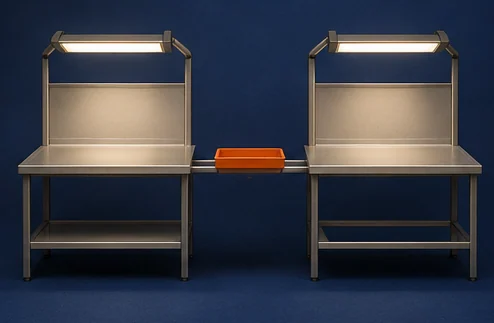
Hand off visual inspection work by giving the next shift the open unit IDs, hold status, evidence, active check version, next action, and named owner. Review work that needs action first, then confirm the receiving shift can find the material and continue the approved process.
Match the written exception to the physical unit
Avoid entries such as “three cartons need review.” Identify the units, their station and hold location, and whether they are waiting for an image, a decision, or rework. A photograph that can no longer be matched to a carton may help diagnose a recurring issue. It cannot release a specific untracked unit.
| Fictional unit | Current state | Receiving action |
|---|---|---|
| C-228 | Held at station B, side image missing | Recapture and attach both views before deciding |
| C-240 | Rework completed, original flag preserved | Obtain a post-rework decision |
| C-261 | Awaiting quality lead’s rule interpretation | Confirm who owns the decision and due time |
Include temporary operating conditions
Tell the receiving shift when a fixture was moved, a format was restricted to manual checks, or one camera view went out of service. Distinguish the active baseline from temporary coverage. Record when the temporary condition expires or when an owner must reassess it. Confirm that any partial rollout has a version recorded on each relevant work item.
The elapsed time between capture and review can matter more than shift totals. Review the oldest held units, their deadlines, and the corresponding approved fallback. If the next owner lacks access to an image, honor the hold and retrieve it through the approved process.
Close the loop on each inherited item
Have the receiving lead acknowledge the list and confirm any unclear entry during overlap. At the next check-in, inspect outstanding IDs against the queue. Preserve the original decision, subsequent action, and final release evidence. Review repeated missing-image handoffs as a station process problem.
Use the shift handoff worksheet and review routing map to agree who takes each action.
Start with the physical items waiting for a decision
Meet where the incoming lead can see the held units, the station queue, and the record used for physical disposition. Ask the outgoing team to name items whose outcome can still change, where they are, and how long they can remain available. A daily quality summary may describe general conditions. The receiving person first needs to know which specific carton, tray or assembly they must act on. List the current status and next authorized action for each item that could matter before the ordinary report is read.
Use the physical and digital identifiers together. Name the unit ID, carrier or container reference where applicable, and the most recently verified location. Keep a unique record even if a carrier will circulate to another station. A shelf label or line location can help a person find the item but may change when somebody moves it. Record custody or transfer as an event and confirm it through ordinary staff procedures. The receiving team should know what evidence establishes the item’s identity after a delay.
Keep confirmed and provisional outcomes separate. A visual flag can cause a hold and still require someone to perform a reference inspection. A provisional note can suggest a likely result. A QA authority may issue a final disposition. The handoff should identify which has occurred and what the next person can still do. Show the relevant timestamps and avoid replacing a prior “held for review” reason with a later observation that lacks its authority. The record should show why the unit is currently available and who can release it.
Reconcile before accepting the shift. Compare each open electronic case with its real item or an approved trace of transfer. A case with no locatable unit needs a named separate action. A physical item isolated without a matching record needs a new trace and an authorized current check. A correct count alone cannot show that the identities match. Resolve duplicates or uncertain relationships through the accepted local procedure, with the original observations still recoverable.
Choose a handoff record that someone can scan quickly
Use the fields the next team actually needs. Common essentials include a stable unit identifier, physical location, applied configuration, current state, reason, last usable evidence link, required next action, owner, and target time. Include the relevant reference version and applicable temporary restriction. If an item must be assessed in another area, specify the receiving role and where it was transferred. A brief header can show date, stations in scope, staff coverage, and any open setup matter needing attention before regular checks.
Make difficult cases easy to find. Sort by earliest approved time to act or whatever priority rule the site uses. Keep matters needing immediate physical control visible above ordinary notes. Use status names readers can interpret and include the short reason. An entry that says “check” without an applicable instruction or decision owner puts the next person in the same position as the last. Use a separate note for supporting investigation rather than hiding action details in long free text.
Record the actual queue source and how to retrieve older evidence. A handoff prepared from an exported sheet may list the right item but not include a usable link for the receiving role. Make sure the destination user has the authorized viewing permissions. Store only the relevant images and records in the approved locations and follow the organization’s retention rules. Put lengthy case history behind an appropriate link and keep the part that changes immediate action visible.
Read the inspection shift handoff worksheet as a starter. Give the incoming shift one recorded case and ask them to find its current unit, applicable instruction and next role with ordinary access. If they need to ask the preparer what a short code means, revise the handoff. A well-designed form supports retrieval during a transfer while leaving complete history in the appropriate case record.
Handle items that cross a cutoff
Describe which observations and decisions belong to each shift. A unit captured during the previous shift may still be open during the next one. Its initial observation remains associated with the earlier shift and configuration. If it is resolved after turnover, the newly authorized outcome and time belong to the receiving action. Use stable unit and event IDs to support both views. Avoid assigning unresolved older cases to the latest shift as if it created them.
Choose a cutoff aligned to operation, such as a change of ownership or a verified window boundary. State the time basis, including any differing local or system clocks when needed. Roll up unresolved items at the boundary and track the later disposition separately. If one application records only the latest state, keep a verified history or export that establishes what the incoming team actually inherited. That supports investigation of delays and traceability.
Consider a fictional period with nine cases still held at shift change. Two leave through an authorized manual procedure before the receiving meeting, four are verified in the assigned staging area, and three were transferred to a separate station for independent checks. The incoming physical inventory may show four cases and still leave responsibility for verifying all nine outcomes. Resolve which entries are already closed, which reside in the room, and which need a receiving acknowledgment elsewhere. The final handoff should state who owns each remaining action.
Exercise a delayed status. An earlier automatic result may arrive after the incoming worker has found and inspected the item manually. Preserve the history and route any disagreement according to authority. A delayed event or timestamp from another process should not automatically replace a later authorized decision. Test the ordinary system view and confirm which state it presents to someone who can act on the actual unit.
Carry the active rule across a configuration change
Visit one old-format unit before changing the line to a new format. Its capture uses the recorded original lighting, crop and product requirement. If it remains open when the changeover occurs, agree on which rule the receiving person will use and how they’ll retrieve it. If the responsible authority approves re-evaluation under a current method, record the prerequisite and whether an updated capture is necessary. Never assume that an overnight update retroactively changes what an earlier image can demonstrate.
After changeover, verify the supported scope with the incoming station lead. Confirm which view and format are actually in use. Run the controls appropriate to the current procedure, including one known expected exception. Have the receiving person show how to tell whether the new result uses the actual intended rule. If a necessary reference is unavailable, follow the approved alternate route and name what must be checked before the station resumes its broader role.
Record conditions of a temporary procedure clearly. A fixture adjustment might make an alternate view necessary on one lane. An open equipment investigation might require manual inspection on one product until a particular condition is checked. State exactly when the procedure applies and what authorizes its end. Keep the active restrictions visible during the handoff. If someone changes the affected scope, update the record where the next shift will use it and link the actual authorization.
Keep both configurations retrievable where they remain relevant. A production display might show only the active recipe for the station, while reviewers need to interpret older observations under earlier settings. Preserve the applied version and applicable reference on the case or its linked evidence. Verify that the incoming role can recover an older record. This matters most when many otherwise similar units are processed with different limits or evidence requirements.
Transfer rework and recapture with the earlier evidence intact
A unit sent for rework can have an initial failure, an approved change, and one or more later observations. Keep the earlier finding and what physically changed. Record which reference was used before and after, and whether the current physical stage allows the earlier evidence to remain valid for any other part of the inspection. Only authorized dispositions can close a hold. Show if the new photo is expected, when it can be captured, and what the receiving role must check before the final decision.
A recapture can complete a needed observation without physically changing the unit. A rework event is different and may affect earlier valid results. A new carton or carrier can also change identity or custody. Train staff to record the applicable event type and trace a real case where the difference matters. An old photo of a correctly packed interior may be useful through a documented transfer. Repacking can require current verification depending on the instruction and process.
Suppose a fictional tray was held for a missing insert. The outgoing worker adds the approved insert and leaves a label saying “ready for recheck.” The receiving shift should see the original image, what action was performed, which status is authoritative, and a way to confirm they have the correct item. An after-rework picture can verify the new state if it meets the relevant instructions. Keep both stage identities and avoid converting the earlier failure into an unexplained pass.
Include examples where a new image is not enough. A pre-close view might be retrievable, but the unit’s seal has since changed and the content could have moved. A package could be damaged on its way to an alternate station. Some approved operating procedures require inspection of the current physical condition or earlier observations paired with documented controls. When the evidence is inadequate, preserve the unresolved state and notify the responsible owner promptly.
Plan for missing workers or blocked stations
List who can handle work if the expected owner is not present. A receiving lead might cover an ordinary evidence check and lack authority for a disputed quality requirement. A specialist can resolve a complex issue and need help physically locating the unit. Define the escalation contact by role and the fallback condition with the site owner. Make sure people know how to report that they cannot cover a role in the promised time.
Rehearse a busy turnover case in which the next team cannot immediately use the alternate camera. Record which items remain in protected isolation and which can proceed with an approved independent check. Validate that the queue still uses the correct unit and current instruction when a second station becomes available. Time the expected recovery and ensure someone can see the oldest item, not just the number waiting. Add an orderly return to normal operation once the authorized owner verifies the expected reference behavior.
Avoid loss of responsibility during split shifts. Two people receiving different lanes may assume the other owns a shared queue. Assign each open case and verify at least one transfer where responsibility changes while the item stays in place. Confirm where the record shows that the new role accepted it. If the primary reviewer goes away, exercise how the remaining roles can recognize a case beyond a documented time limit and apply the expected escalation.
Keep a suitable route available during service failure. If the review interface is unavailable, a procedural record in the approved system may help staff track items and reconcile them after service returns. Decide how to preserve the evidence and connect any later automated result to the case already handled. Make sure the record can distinguish a confirmed physical action from an unverified observation. Test the fallback through normal access and roles rather than relying on elevated access during a rehearsal.
Discuss recurring surprises at turnover without re-running the whole pilot
An outgoing worker has useful context about the last window, including fixture movement, product changes, loss of references, and which alternate path helped. Record short facts and specific current restrictions. Keep broader hypothesis and next tests in the quality record. A new lead should know which situations might recur and whom to notify, rather than being asked to reconstruct a long investigation before handling the first case.
Use a short example to transfer practical knowledge. Show one relevant image that explains a common review reason, and one related legitimate variation. Have the receiving person explain which features matter and where an approved reference is found. Do not turn a provisional workaround into a new acceptance rule without the responsible owner. If an approved rule is unclear, state the current safe handling procedure and the evidence being requested.
Review paired timing evidence where delays commonly occur. A case might have arrived late due to a system queue, or been visible but remained unassigned, or could not be located because the physical item moved. The right next change depends on which interval increased. Give the receiving lead a tangible observation from the last shift and one thing to measure in the next similar window. Record what authority applies and what the workflow expects under usual conditions.
Keep ordinary condition checks within the handoff. Confirm the equipment and current product family, any setup changes that could affect the view, and the responsible role for new exceptions. Ask the person taking over to use a known accepted, known flagged and known unresolved example where appropriate. If the ordinary configuration can be verified without a long exercise every shift, make the quick check reproducible and record why it is sufficient for the supported situation.
Rehearse how an unresolved case changes hands
Create a short exercise with five fictional items. One is waiting for a second view, another is disputed under one approved boundary, a third is physically moved to a review bench, a fourth was cleared by an authorized person during the last shift, and a fifth has a missing digital identity. Give each a visible operator state and a corresponding ground-truth action the receiving lead can recover from available evidence. Ask them to reconcile the five manually.
Document the order the receiving lead chooses and why. They may need to address the item closest to closure first, verify the held material that could exceed available space next, and then contact the product authority for a close boundary. Identify an action that uses an existing status and one that requires more evidence. A missing record may have to remain unresolved until a person establishes the correct identity and condition. Keep the scenario realistic for the people who actually do the work.
For the item moved off line, verify that the receiving station has both responsibility and appropriate access. Read back the actual reference, last evidence state, and authorized decision a person can make. If the receiving role cannot find the right photograph or unit, include an explicit request and owner. A successful digital transfer alone does not guarantee the material reached its location or the correct person.
For the unit already cleared, confirm that the recorded action survives any late event. Test whether the display silently reopens the case when an old capture response arrives. The authorized state needs a visible trail and any follow-up should follow the accepted procedure. Match identities in the event history and verify event timing rather than basing the handoff solely on the latest message.
Learn from counts without losing the distinction between units and events
At cutoff, assemble counts of units waiting and the reasons or paths that matter. Show how many are nearing the observed limit, how many were inherited, and how many moved to approved fallback. Use a stable population and scope. A unit moving through multiple wait or recapture states can generate several events. Those events help calculate time spent and trace responsibility. The physical queue count should use unique units and show what can still be found.
Review completed cases as a separate set. Record whether an early action was confirmed, changed by independent evidence, or completed under a fallback. If some classes commonly wait across two shifts, investigate whether the original handoff provides enough evidence or needs earlier ownership. Compare ordinary unit volume and staffing before attributing the problem to a specific shift. Rehearse the change rather than only changing the report.
Audit handoff coverage on a small selection. Pick a real unit from each relevant open reason and find it physically or by authorized transfer evidence. Check when it started waiting, which roles handled it, and what its final result was, when known. Look at the hardest case, the normal one, and a case resolved without the preferred service. A dependable report can explain each of those outcomes and when actual responsibility changed.
Use the receiving shift to verify the closeout is complete
Have that lead repeat the result in their own words and identify the first action. Write whether the case is settled, open with an owner and due time, or unable to progress under the currently available evidence. Preserve any approved restrictions and the conditions for ending them. Confirm the real unit, authorized action, and where the next person can find the most useful evidence.
Finish before routine activity makes it harder to reconcile cases. Recheck the count and location of physical holdings, who owns every open case, and any current procedure someone needs to recognize. An outgoing status is useful when the next team can retrieve the correct evidence and move the unit under the approved instruction. That is the operational measure of whether a handoff worked.
Work through a handoff at two stations
Imagine a fictional line with an imaging station at packing and a separate table for physical review. A tote holds four units. One is correctly on hold for a visible omission, two wait for identity confirmation, and one was moved to the table to resolve an unreadable region. During the last hour an operator raised the guide to accommodate an approved material change, and the two unclear captures were generated shortly after that adjustment. Use the station records to identify the current items and actual settings. Assign an owner at each physical location.
At the packing station, make sure the new guide position and supported product family are approved for the receiving shift. Exercise a first piece with a known required feature and check that the receiver can find the applicable instruction. The two units with unknown identity should retain their earlier state until somebody establishes which group they represent. They may or may not be affected by the guide adjustment. Give the receiving operator the source needed to verify identity and tell them which next action applies if that evidence remains unavailable.
At the review table, transfer responsibility for the one item awaiting physical observation. Provide the initial view, missing region and current authorized reference. Have the receiving worker find the physical item and know which decision they are authorized to make. Check whether the visual limitation arose before or after the station adjustment. Confirm which observation was valid at capture and whether the authorized physical check resolves what the earlier image could not show. Record the timeline without replacing the original route.
For the known omission, verify that its hold was based on the correct requirement, then check which approved rework is possible and when updated evidence will be needed. A physical bag attached to the carton can carry enough information to recover its identity. It should stay linked to the relevant record and clear reason. Do not expect an informal mark to supersede the institution’s applicable procedure. If a shared report reads both locations, preserve the event that linked the held item’s departure and arrival to the same unit.
Test what happens if the line continues with new work while the outgoing cases are resolved. A new carton can carry the same supplier label as one of the older ones. The identity and actual order should still distinguish the units. The new shift can exercise one normal and one out-of-scope case without referring to the old team. Check what the case queue displays when a new camera frame is received after an older item is manually closed. Ask the receiving person to account for both items in their separately authorized states.
Write a transition summary for cases without a physical hold
Not every vision result creates an isolated unit. In shadow operation, the image tool may produce recommendations that a person evaluates after the normal inspection. Distinguish that scenario in the handoff. A review record may need a later reference outcome and can no longer change the physical disposition. Make the observational purpose explicit and identify any already authorized operational action. An open shadow finding should not look like a physical unit someone must stop.
For one fictional example, a trial generates a delayed “potential missing component” recommendation after a carton has already received an independent approved confirmation. Record the difference as a case to compare evidence, not as an automatic authority to reverse the later action. Identify which frame and rule the proposal estimates and link the established reference. If the procedure calls for a separate review of suspected product impact, notify the owner with the traceable scope. Do not ask a new shift to rewrite historical results merely to make the list agree.
If retrospective review requires reference outcomes, decide what can be recovered. A later accepted product measurement may show which instruction and stage were evaluated. Earlier views can lack necessary evidence about conditions that no longer exist. Preserve the distinction between observations that can be checked against a known reference and ones that remain unresolved. Record why the unit was unavailable and which independent sample could answer the operational question later.
Separate this handoff view from active exception management. The receiving team can prioritize live items and give shadow findings their own review cadence. Keep any urgent real signal visible under the approved notification procedure. Give the investigator the corresponding case IDs and decision states so their eventual update does not imply that earlier staff had a different outcome available at the time.
Evaluate the handoff under difficult but expected conditions
Rehearse a short interruption when the active application is unavailable. Use an authorized alternative record to establish which areas have physical holds, which cases are open, and what current instruction applies. Have the incoming lead retrieve at least one piece of evidence by the approved fallback. If the case can be handled manually, show how the authorized result is logged and later reconciled. If it cannot, record who continues its custody and when the next review can occur.
Exercise a shift with no overlap. The outgoing lead might leave before the backup reviewer starts. A running line can receive new results in that gap. Determine which person or procedure owns new and already open units. Record the point where responsibility changes. Verify that someone can interrupt automatic activity under the approved rule if the necessary receiving authority is absent. Test the backup procedure with one item that reaches its decision timeout.
Include transfers using the normal controls for personnel access. A maintenance worker can share the available camera condition without changing a quality hold. A supervisor with authority to release may need to verify work already completed by an operator. Keep the information and authority attached to the actual role. If a system refuses the receiving worker access, the workflow should retain the existing state and show an authorized route for help. Exercise this with expected roles rather than temporarily granting people abilities they would not have on shift.
Check the receiving person’s ability to see version timing. A shift may overlap an instruction update and a utility interruption. Older images can still be valid evidence for one question and inadequate for a new requirement. Preserve the actual capture time and intended instruction. Keep prior and current procedures retrievable. If the later release requires a recapture, make the link and responsibility visible as part of the exercise.
Decide what a good handoff must demonstrate
An effective closeout should account for all known in-scope items, identify the actual current states, and name a responsible person for each unsettled action. Validate this with more than a count in a report. Take one physically held item, one electronically unresolved case and one settled reference. Recover their individual history and verify the accepted rules. If identity remains unclear, record the source expected to resolve it. Keep the responsible role and due time visible across the transition.
Look at actual timing. Cases whose allowed decision windows run out before transfer need a documented plan before the next shift begins. Cases that can wait may require a place to remain protected. Record the planned time and any known service limitation. Have the new lead confirm receipt of the relevant open items and any temporary instructions. A stable record of this transfer lets production and quality evaluate later whether a delay began at capture, during assignment or during a physical lookup.
Maintain a short training example for the next lead. Choose an unusual case whose evidence, authority or timing could easily be misunderstood. Show how the incoming team found the item, which procedure applied and how the final outcome was recorded. Include one region or rule that the case didn’t establish. This gives a later lead an example they can compare with new circumstances without assuming all open cases follow the longest or most complicated procedure.
Keep a durable acknowledgment for the cases that needed action after the outgoing team left. It should show who took responsibility, the time, and any issue that prevented immediate retrieval. Return one resolved outcome to the earlier queue record so the next report can reconstruct the complete event path. For a case that still cannot be settled, include which evidence source has been requested and which approved custody applies until it arrives. These details give a later quality review more than a generic indication that two people discussed the shift.